Teaching about European explorers and the Age of Exploration can be an exciting and eye-opening experience for your students! If you’re searching for ways to make your unit informative, engaging, and thought-provoking, look no further.
Today’s blog post will share activities to help students interact with and comprehend the important historical events and figures of the time in ways that captivate student attention and take it “beyond the textbook.”
Additionally, we’ll share some ideas to get students thinking more deeply about the varying perspectives surrounding the events that took place. Finally, we’ll wrap up by suggesting an important critical thinking prompt to provide some thought-provoking closure to your unit.
What was The Age of Exploration? (In a Nutshell)
The Age of Exploration refers to a period in world history beginning approximately in the 1400s and ending in the 1600s when European countries began exploring the world.
Nations such as Portugal, Holland, England, France, and Spain launched westward expeditions in search of new trade routes, knowledge, wealth, and glory.
European explorers discovered many new lands and claimed them for their countries, despite the presence of indigenous peoples. Although the Age of Exploration led to massive wealth for European colonizers, and improved the knowledge of the geography of the world and its resources, it also caused the decimation of many indigenous peoples and led to the slave trade.
Some well-known explorers of this time include Christopher Columbus, Juan Ponce de Leon, Ferdinand Magellan, Hernan Cortes, Francisco Pizarro, and Francisco Vazquez de Coronado, and more.
This period of history can be complex, so it is crucial to use some engaging activities and thinking prompts to help support and enrich students’ understanding.
European Explorer Activities: Comprehension
<<European Explorers Color by Number>>
This activity is such a fun way to help students comprehend European explorers in an engaging and interactive format! Students will complete a “before reading” anticipation guide, then read about European explorers, marking the text for evidence as they go. Then, comes many students’ favorite part, the coloring! Students will color the picture according to their answers. Finally, they’ll complete the “after reading” questions.
The reading passage covers topics such as Age of Exploration, Christopher Columbus, Henry Hudson, Hernan Cortes, Francisco Vasquez de Coronado and Ponce de Leon.
This activity is perfect to use at the beginning of a unit to assess prior knowledge, or you can use it at the end as a review. You could even use the student worksheet as a quiz and then let students color the picture as a reward! Choose what works best for you. Don’t forget to hang up students’ finished products!
Interactive Google Slide Presentations
Also available in PowerPoint form, these interactive presentations help students become familiar with explorers such as Christopher Columbus, Hernan Cortes, Amerigo Vespucci, Ponce De Leon, Francisco Pizarro, Ferdinand Magellan and more. Students read a short passage about an explorer, then answer a self-checking question, and repeat. Also incorporated into the presentation are “words to know” which help students define vocabulary that will appear in the passages.
These presentations are a great reading comprehension activity that provides an overview of important European explorers of the time. Use for homework or as a review, introduce the explorers one at a time or set them up as a stations activity where students have to rotate from one explorer to the next.
Digital Escape Rooms and Puzzles
If you really want to wow your students and engage them in important understandings about European Explorers at the same time, try an escape room or puzzle station activity!
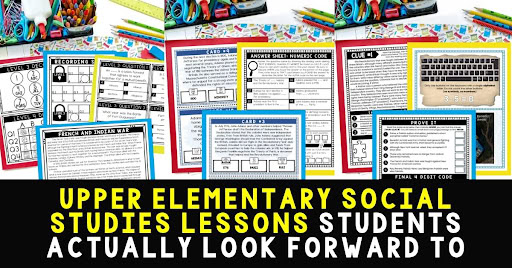
You’ll find tons of Digital Escape Rooms in the Think Tank Teacher store that cover European Explorers. Each Digital Escape Room will take students on a secret mission through two
360° VIEW rooms! Along the way, students will decode interesting facts about the explorer and his discoveries. Students will read 4 short passages, then answer questions related to each passage. After correctly answering the questions, they will be given a “clue.” They will then decode 4 puzzles to help them determine the final lock code!
Students can work in pairs (or individually) and race against the clock. Of course, a little friendly competition always increases engagement! These escape rooms ensure that students actually read the passages because they must answer 3 questions about each of the 4 passages correctly to move on to the puzzle decoding.
You’ll find Digital Escape Rooms for explorers such as Ferdinand Magellan, Amerigo Vespucci, Ponce De Leon, Francisco Pizarro, and more! You’ll love watching students build their knowledge of the Age of Exploration as they use critical thinking, collaboration, and problem-solving skills along the way. Of course, you’ll also love that these activities are no prep and provide immediate student feedback! Students will love completing a unique, challenging digital activity!
The Christopher Columbus Puzzle Stations activity is a similar resource but is not digital. Students move around the classroom instead of using the computer, answering questions and solving puzzles as they go! This is another, no-prep, print-and-go activity that you and your students will love!
European Explorers: Perspective-taking and Critical Thinking
As mentioned before, the study of European explorers can be an experience that is eye-opening for students and widens their worldview. It is important that we provide students with ways of thinking about the Age of Exploration that helps students understand the varying perspectives of those involved in these key world events.
One way to do so is by providing some critical thinking prompts that can be used as discussion starters or writing prompts. Try asking students the following questions:
Question 1
Pretend you are outside playing on a warm spring day. Suddenly, seemingly out of nowhere, you see 3 large ships floating down out of the sky. They’re huge, bright, and colorful and seem to be gliding slowly down to Earth until they land right in your neighborhood. What are your feelings? What do you plan to do next?
This question allows students to begin thinking about the perspectives of Indigenous peoples’ perspectives when foreign explorers suddenly and inexplicably appeared on their lands. The answers and reactions that students produce to this question can generate so many important understandings.
After this discussion, you could follow up with a picture book such as Encounter by Jane Yolen which tells the story of Christopher Columbus’s arrival on the island of San Salvador in 1492 from the perspective of a young Taino boy. He is wary of the new strangers and tries to warn his people. His viewpoint demonstrates the curiosity, confusion, and fear felt by the Tainos people upon the arrival of the colonizers. At the end of the story, the young boy is now an old man who looks back at the devastating impacts on his people and culture due to colonization.
Question 2
Although we’re listing it as “question 2” the following question might be more useful at the beginning of your unit on the Age of Exploration. Here’s the scenario:
Scientists have discovered 7 additional continents (you could also use “planets” here if you want) and have realized that the world (or galaxy) is twice as big as you thought it was. You are a part of the task force that has been assigned to explore these new places. What questions do you have? What will you want to discover? What will you find in these new places? What will the next plan of action be once this discovery has been announced?
This helps students get a sense of the allure of the “new world” that colonizers were drawn to, and encourages students to think critically about what the goals and intentions were of the nations that set out into unknown lands.
Closing Question
Once your students have discussed or written about the questions above and have worked through engaging activities to learn about European Explorers and the Age of Exploration such as Digital Escape Rooms, puzzle stations, interactive Google slides, Color by Number activities and more, they have gained an incredible amount of knowledge!
One way to provide closure is to ask the following critical thinking question: Is it valid to celebrate, put up statues, and name cities after some of these European Explorers? Why or why not?
Better yet, ask students to write about this question and support their answers with evidence from what you’ve learned about in class!
Learning about these crucial moments in world history and well-known European Explorers can be an exciting, interesting, and important experience for your students. We hope that these activities and suggestions can make the unit truly come alive in your classroom!
Prefer to use non-fiction chapter books to teach European Explorers? Read the blog here.