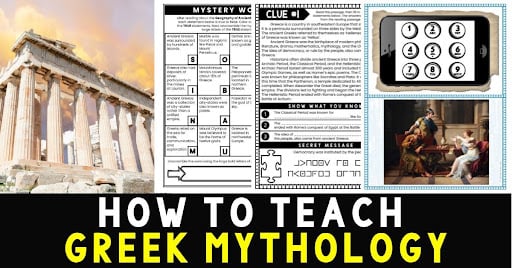
Teaching Greek mythology? Get started learning more about Greek Mythology through the Ancient Greece interactive workbook. Try exploring the Titans and Olympians, Greek Mythology books for middle school students, and even fun videos. Check out all these fun activities and learn how to teach Greek Mythology in the classroom, whether you are a homeschool or traditional teacher.
Why Should You Teach About Greek Mythology?
Why teach Greek mythology? Because it’s packed with fascinating tales that have shaped literature, language, and culture for thousands of years! From mighty Zeus to clever Odysseus, these stories are more than just entertaining. They help students understand ancient beliefs, values, and the roots of modern storytelling. Greek myths explain natural events, teach life lessons, and even show up in books, movies, and everyday phrases we still use today. The Ancient Greece interactive workbook brings these legendary adventures to life, making learning both exciting and meaningful.
Why Should You Teach about Greek Mythology with an Interactive Workbook?
1. Active Engagement
To start, adding games to your Greek mythology lessons brings a whole new level of excitement to learning. Also, when students are having fun, they are more likely to stay on task and complete their work with enthusiasm. Interactive activities help keep them focused and involved, without losing interest or getting distracted. As they explore legendary stories of gods, heroes, and mythical creatures in the Ancient Greece interactive workbook, they return to the material to solve puzzles and tackle challenges. Students do this all while picking up important details without even realizing it.
2. Encourages Critical Thinking
Another big benefit of using games to teach Greek mythology is that it helps students develop critical thinking skills and connect different pieces of information they’ve learned. As they work through challenges and look for clues, they’re taking a closer look at the myths and thinking about what they’ve read. Of course, doing this through fun activities in the Ancient Greece interactive workbook is much more engaging than simply reading a textbook and answering traditional questions.
3. Reinforcement Through Fun
Next, using games in the Ancient Greece interactive workbook helps your kids want to reread passages rather than just skim and move on. The fun games and puzzles help your students learn about Greek Mythology while reinforcing concepts related to Titans, Olympians, and more!
4. Incentive to Learn
Of course, students engage and learn when they compete with one another or even against themselves! Winning is huge when it comes to engagement and motivation in learning. Through puzzles and mystery codes in the Ancient Greece interactive workbook, this brings Greek Mythology alive.
5. Increased Motivation
Speaking of motivation, engagement, games, competition, and reading challenging passages help your students get motivated to learn more. Don’t worry about the lectures with the Ancient Greece interactive workbook. They will want to learn about all the topics in the workbook beyond Greek Mythology.
6. Versatile Use
Whether you’re a public, private, or homeschool teacher, you will benefit by using the Ancient Greece interactive workbook in your curriculum. Also, you can use the workbook for so many purposes in the classroom, from review sessions, introductory/anticipatory sets, independent work, or group work.
7. Promotes Positive Reinforcement
Immediate answers? Yes! It’s not necessary to wait for feedback and grades. With the Ancient Greece interactive workbook, your students get immediate feedback and know when they solve the puzzles or codes that they have the right answer. Finally, this takes away the frustration and the waiting while providing positive reinforcement.
What Greek Mythology Topics are in the Ancient Greece Interactive Workbook?
1. The Titans
First, the Ancient Greece interactive workbook explores the powerful world of the Titans, the ancient gods who ruled before the Olympians. First, your kids learn about Gaia and Uranus, the first deities, and their children, including the Hundred-Handed Ones, the Cyclopes, and the twelve Titans. The workbook highlights important Titans such as Cronus, Rhea, Oceanus, Themis, and Hyperion, explaining their roles and connections in Greek mythology

It also tells the dramatic story of how Cronus overthrew Uranus and how the Titans were later defeated in the Titanomachy. Through engaging stories, puzzles, and activities, students gain a deeper understanding of these legendary figures in a fun and memorable way.
2. The Olympians
In addition, the Ancient Greece interactive workbook explores the fascinating world of the Olympian gods, the powerful deities who ruled after the Titans. Students will learn how Zeus, the youngest son of Cronus and Rhea, escaped being swallowed by his father, grew up in secret, and freed his siblings. Together, they defeated the Titans in a great war and took their place as the rulers of Mount Olympus. The workbook introduces each Olympian:
- Zeus: god of the sky
- Poseidon: god of the sea
- Hades: god of the underworld
- Hera: queen of the gods
- Demeter: goddess of the harvest
- Hestia: goddess of the hearth
- Athena: goddess of wisdom
- Apollo: god of light and music
- Artemis: goddess of the hunt
- Ares: god of war
- Hephaestus: god of craftsmanship
- Hermes: the messenger god
- Dionysus: god of wine
- Aphrodite: goddess of love
Overall, through code activities, readings, and puzzles, students will discover how the Olympians shaped ancient Greek beliefs and daily life.
What are Some Other Activities to Teach Greek Mythology in the Classroom?
1. Greek Mythology Books for Middle School
Of course, integrating literature is also a powerful way to teach Greek mythology, especially for middle school and upper elementary students. There is a wide variety of engaging books that bring the world of gods, goddesses, heroes, and monsters to life through storytelling, illustrations, and even modern retellings. These texts not only spark interest but also create strong cross-curricular connections between English and Social Studies. From classic anthologies to modern guides and dramatic adaptations, these books also provide rich opportunities for reading, writing, art, and performance activities that deepen students’ understanding of Greek mythology in fun and meaningful ways.
2. Greek Mythology Escape Room
Next, try some fun escape rooms to study Greek Mythology. In this engaging Greek Mythology digital escape room, students explore two interactive 360° view rooms while uncovering clues and learning key facts about Greek gods and goddesses. These include Zeus, Hera, Poseidon, Hades, and Athena. The escape room features four activity sets. Each starts with a short reading and a quiz, with a built-in read-aloud option to support all learners. Activities include a cryptogram, maze, cipher, and jigsaw puzzle. As students crack secret codes to unlock each stage, they stay fully involved in the adventure. This escape room works great as an extension activity after reading Greek Mythology books. Also, it can be used as an exciting introduction to your mythology unit.
3. TED-Ed Greek Mythology Videos
Next, TED-Ed has videos on so many different topics! Greek Mythology is no exception. Add these videos to introduce topics in the Ancient Greece interactive workbook to get your kids excited about the myth of King Midas and his golden touch, a tour of the Ancient Greek underworld, Demeter’s revenge, and even Arachne. There are even more TED-Ed videos to support student learning about Greek Mythology!
Overall, Greek mythology is an important part of the Ancient Greece interactive workbook and all things Ancient Greece! Using the workbook, other Greek Mythology books and resources, and also videos, is the perfect way to teach Greek Mythology in the classroom. How will you start your unit?