Teaching the American Revolution: How to Use American Revolution UNLOCKED for Kids
Let’s be real. Most kids hear “American Revolution” and picture a dusty list of dates, taxes, and men in powdered wigs. As teachers and homeschool parents, we know the real story is anything but boring. It’s full of secret societies, midnight rides, smuggling, mob action, and a tea party that cost a fortune. The trick is getting students to feel that.
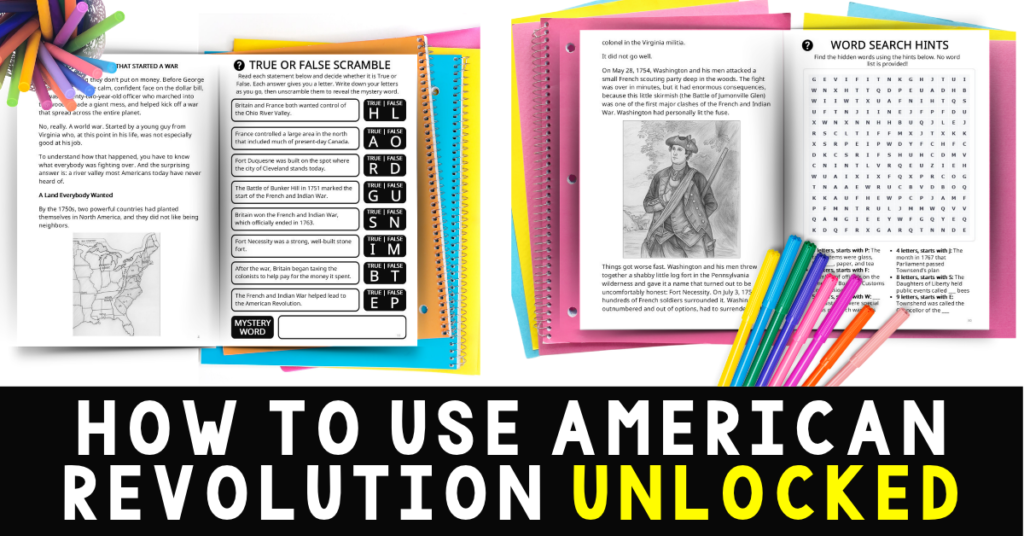
That’s exactly what American Revolution UNLOCKED for Kids by Lisa Fink does. In 12 fast-moving chapters, it walks kids from the French and Indian War all the way to the “shot heard ’round the world” at Lexington and Concord. Every chapter ends with a myth-busting bonus story and a puzzle that checks what students learned.
In this post, I’ll break down the main teaching topics in the book and share practical ways to use each one in your classroom or homeschool. Think bell ringers, pre-reading hooks, think-pair-share prompts, essays, projects, and review games, all pulled straight from the pages.
A Quick Look at American Revolution UNLOCKED for Kids
This isn’t a textbook, and that’s the point. Each chapter opens with a hook that sounds like a friend telling a story, like comparing the Sugar Act to Mom suddenly putting a camera on the cookie jar. Kids stay with it because it reads like a page-turner, yet it still gets the facts right.
Here’s what makes it so easy to plug into your lessons:
- Twelve focused chapters: Each one covers a single event or idea, so it slots neatly into one class period or one homeschool day.
- “The Story Goes” pages: Every chapter ends with a legend or little-known story, then asks what we can actually prove. That’s historical thinking built right in.
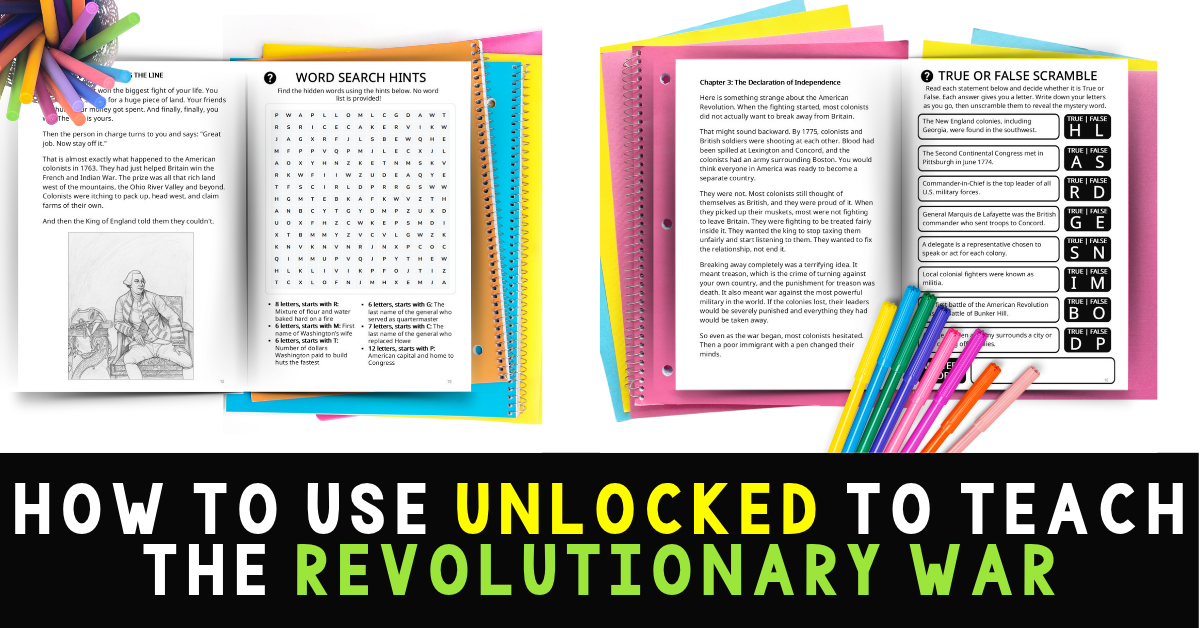
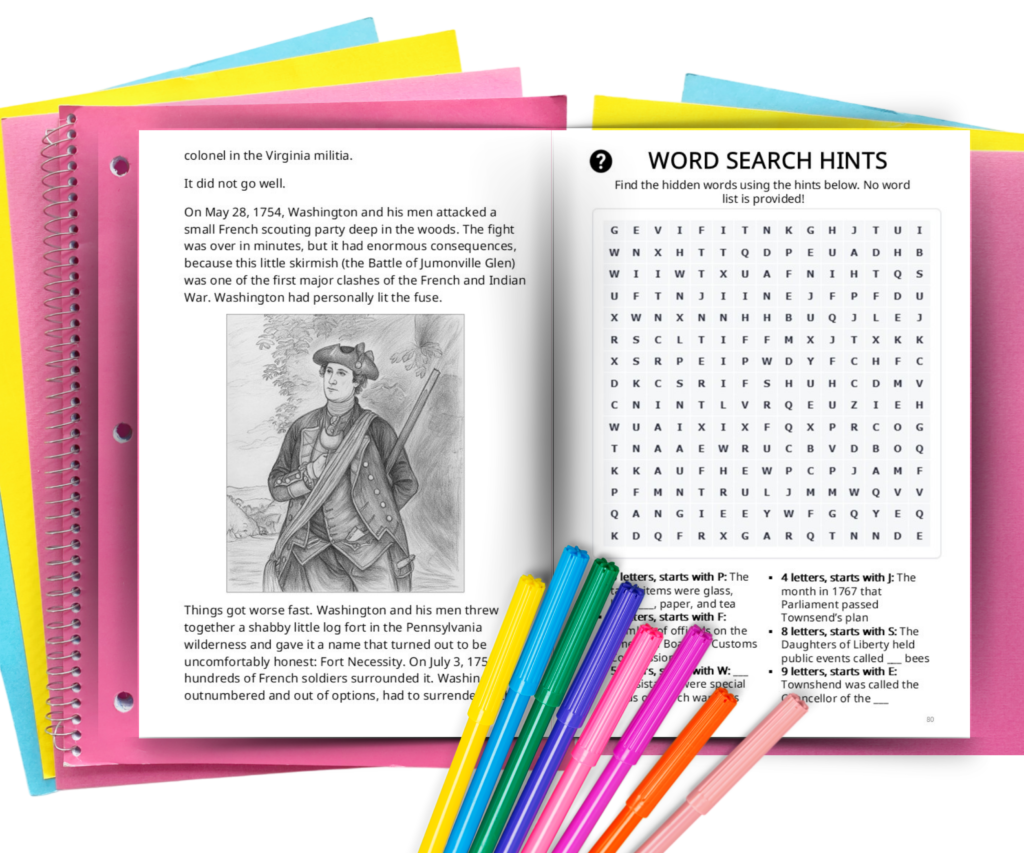
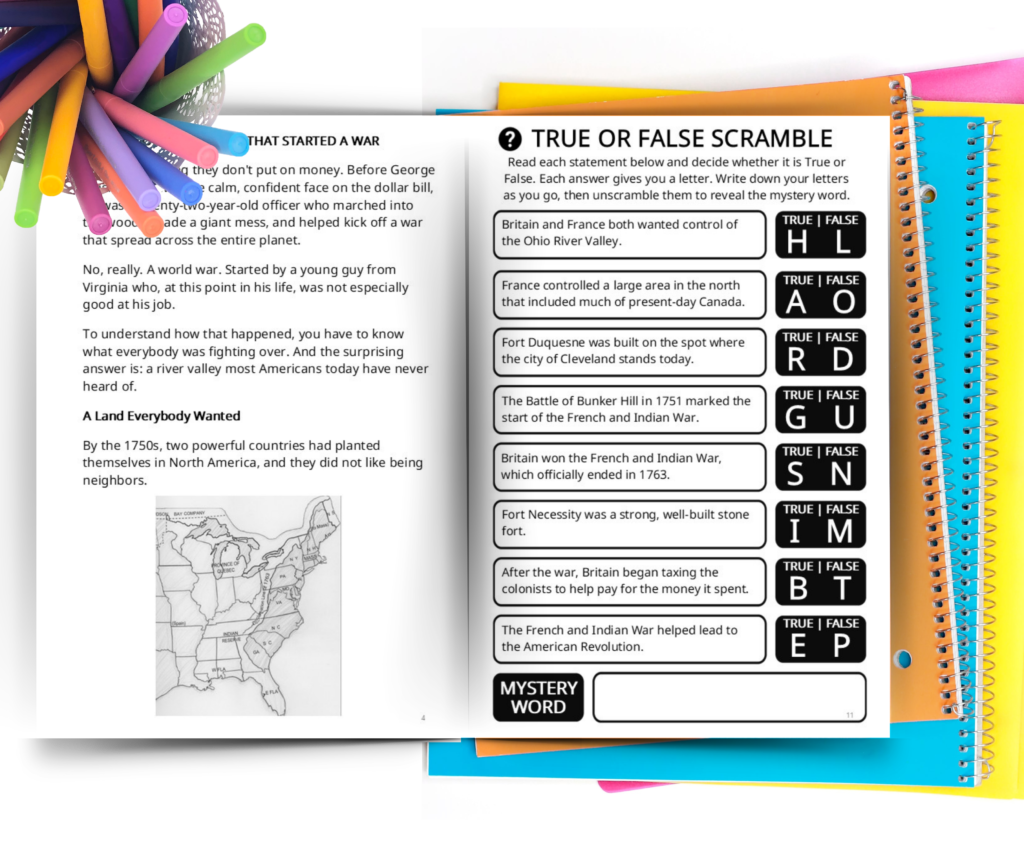
- A puzzle after every chapter: True or False Scrambles, Lock Riddles, Multiple Choice mystery words, coin-value codes, and Word Search Hints with no word list. They work as instant comprehension checks.
- A full answer key: Every puzzle answer is in the back, so grading takes seconds.
- A trusted source list: The book points readers to the National Park Service, the Library of Congress, the Massachusetts Historical Society, and other reliable archives for further research.
In short, it’s a ready-made supplement. You bring the lesson plan, and the book brings the story, the check for understanding, and the answer key
What’s Inside? 12 American Revolution Teaching Topics and How to Use Them
Here’s my favorite part. Below are the main topics in the book, a little background on each, and ideas for turning each chapter into a lesson your students will remember.
1. The French and Indian War
The book opens with a surprise: a 22-year-old George Washington helped start a world war in the Ohio River Valley, on the spot where Pittsburgh stands today. He even surrendered at Fort Necessity, the only surrender of his life. The war left Britain buried in debt, and that debt is the root of every tax that follows.
- Pre-reading hook: Show a dollar bill and ask, “What do you think this man was like at 22?” Then reveal he lost his first battles.
- Map activity: Have students shade British, French, and Native lands, then circle the Ohio River Valley.
- Cause-and-effect chain: Start a classroom anchor chart with “War debt” in the first box. Add a link after every chapter.
2. The Proclamation of 1763
After the war, King George III drew a line along the Appalachian Mountains and told colonists not to settle west of it. The book explains Pontiac’s War and why colonists felt the land they fought for was taken away.
- Bell ringer: “Is it ever fair for a leader to tell people where they can’t live? Why or why not?”
- Think-pair-share: Students argue the British side first, then the colonist side.
- Lock Riddle review: The chapter’s 4-digit lock puzzle is a perfect exit ticket.
3. The Sugar Act
The cookie-jar opener makes this chapter a winner. Kids learn about smuggling, molasses, customs officers who took bribes, and courts with no juries. Most important, they see the big new question: who has the right to tax the colonies at all?
- Vocabulary front-load: Pre-teach smuggling, Parliament, customs, and treason before reading.
- Create your own comparison: The chapter explains the Sugar Act by comparing it to a camera on the cookie jar. Have students write their own everyday comparison that shows how the colonists felt, such as a new rule at school or home. Share them aloud and let the class vote on the one that explains it best.
- Enrichment: The James Otis “Story Goes” page has a strange twist that makes a great read-aloud. Have students research more about James Otis because his name is often overlooked.
4. The Stamp Act and the Stamp Act Congress
This tax touched almost everyone, from newspapers to playing cards. The chapter covers Patrick Henry’s Virginia Resolves, the Stamp Act Congress, the Declaration of Rights and Grievances, and the sneaky Declaratory Act.
- Primary source connection: Show the tombstone-style newspaper printed the day before the tax began. Ask students what message the printer was sending. Students could also create their own newspaper advertisement.
- Writing prompt: Students write a grievance letter to Parliament as a colonial printer or shop owner.
- Front-loading for civics: Use the Declaration of Rights and Grievances to introduce the idea of formally listing complaints. It’s a perfect lead-in to the Declaration of Independence.
5. The Sons of Liberty
The book introduces Samuel Adams, shoemaker Ebenezer Mackintosh, the Liberty Tree, and the mysterious number 45. It’s honest about mob violence, including tarring and feathering, which opens the door to real discussion.
- Debate: “Were the Sons of Liberty heroes, troublemakers, or both?”
- Liberty Tree bulletin board: The Sons of Liberty gathered under Boston’s Liberty Tree to protest. Put a paper tree on your classroom wall. Each time students read about a colonial complaint or protest, they add a leaf with the event and the date. By the end of the unit, the tree is full, and students can see the anger growing branch by branch.
- Assessment: The Mystery Word fill-in puzzle doubles as a quick quiz.
6. The Townshend Acts and the Daughters of Liberty
Colonists fought back by refusing to shop. Students meet John Dickinson’s Letters from a Farmer in Pennsylvania, the Circular Letter, and the Daughters of Liberty, who held spinning bees to make homespun cloth.
- Boycott simulation: Give students a list of “taxed” classroom items and have them plan a boycott.
- Women in history focus: Use the Daughters of Liberty section to show how women shaped the Revolution.
- Review game: The Word Search Hints have no word list, so students must remember the content to find the words.
7. The Boston Massacre
This is one of the strongest chapters in the book for building critical thinkers. Students learn what really happened on that snowy night in 1770, meet Crispus Attucks and the other four victims, and discover that Paul Revere’s famous engraving was propaganda. Then comes the twist: patriot John Adams defended the British soldiers in court.
- Image analysis: Project Revere’s engraving and have students list what they see. After reading, have them list what the book says is wrong with it.
- Media literacy lesson: Define propaganda, then have students find a modern example of an image that tells only one side.
- Argumentative essay: “Was John Adams right to defend the soldiers?” It’s a perfect way to connect to the right to a fair trial.
8. The Committees of Correspondence
The colonies had a communication problem, and the Committees of Correspondence solved it. The chapter includes the burning of the Gaspee in Rhode Island and the threat to send colonists to England for trial.
- Pre-reading puzzle: Ask, “How would you warn 13 colonies of danger with no phones or internet?” Let groups brainstorm before reading.
- Committee letter writing: Divide the class into “colonies.” Each group writes a committee letter warning the others about the Gaspee affair and Britain’s threat to try colonists in England. Groups trade letters and write back with a plan. Homeschool families can swap letters with a co-op or with relatives.
- Modern connection: Compare the committees to group chats or social media networks.
9. The Boston Tea Party
Students learn why the Tea Act was “a trap wrapped in a bargain,” follow the standoff over the Dartmouth, Eleanor, and Beaver, and join the massive meeting at Old South Meeting House. By the end of the night, colonists had destroyed 342 chests of tea.
- Bell ringer: “Would you pay less for tea if it meant accepting a tax? Why?”
- Newspaper project: Students write a front page from the patriot side, then a second one from the British side.
- Math tie-in: Use the 342 chests to build word problems about weight and cost.
10. The Intolerable Acts and the First Continental Congress
Britain struck back by closing Boston’s harbor and passing laws the colonists called “intolerable.” The plan backfired, and 56 delegates met at Carpenters’ Hall in Philadelphia for the First Continental Congress.
- Jigsaw activity: Assign each group one of the punishment laws to teach to the class.
- Role-play: Hold a mini Continental Congress where students represent different colonies with different interests.
- Assessment: The coin-value True or False puzzle makes a fun graded check.
11. Patrick Henry and Paul Revere
This chapter is a goldmine for teaching how history gets written. Students learn that Patrick Henry’s “give me liberty, or give me death” speech wasn’t published until 1817, rebuilt from old men’s memories. They also learn that Revere didn’t ride alone, didn’t shout “The British are coming!”, and didn’t finish the ride. William Dawes and Samuel Prescott were nearly erased by Longfellow’s 1861 poem.
- Myth vs. fact chart: Read Longfellow’s poem aloud, then have students sort its claims into “myth” and “fact” using the book.
- Think-pair-share: “If a speech was partly written by someone else, does it still matter?”
- Enrichment research: Students create a “forgotten hero” poster for William Dawes or Samuel Prescott.
12. Lexington and Concord
The book ends on April 19, 1775, with the shot nobody can explain and the long retreat back to Boston. It also explains where the phrase “shot heard ’round the world” came from: Ralph Waldo Emerson’s 1837 poem.
- Mystery investigation: Ask, “Who fired first?” Have students weigh the evidence and write a short claim with reasons.
- Poetry analysis: Pair the chapter with Emerson’s “Concord Hymn.”
- Unit wrap-up project: Students build a timeline from 1754 to 1775, using the cause-and-effect chain they started in Chapter 1.
Post Reading Activities for the American Revolution
Once students finish the last chapter, they know the whole road from a skirmish in the Ohio woods to the shot heard ’round the world. Now it’s time to put that knowledge to work. These activities pull the 12 chapters together and help students see the big picture.
- The Road to Revolution timeline: Students build a giant classroom or hallway timeline from 1754 to 1775. Each event gets a date, a one-sentence summary, and an arrow showing what it caused next.
- Rank the causes: In small groups, students rank the 12 events from “least” to “most” responsible for starting the war. Each group defends its number one pick to the class.
- Myth-busters showcase: Using the “The Story Goes” pages, students pick one legend from the book and create a poster or short video. It should show the famous story, the real facts, and how we know the difference.
- Patriot or Loyalist journal: Students write five diary entries as a colonist living through the events, from the Stamp Act to Lexington. Ask them to decide by the last entry which side they would choose and why.
- Colonial news broadcast: Teams write and perform a “breaking news” show covering three events from the book. Have one team report from London to show the British side.
- Build-your-own puzzle: Students design a True or False Scramble or a Lock Riddle for a chapter, just like the ones in the book. Then classmates swap and solve. It’s review disguised as a game.
- Culminating essay: “Was the American Revolution about taxes, or about something bigger?” Students must use evidence from at least three chapters.
- Looking ahead: The book ends by teasing the Declaration of Independence. Use that as your bridge into the next unit by having students predict what the colonists’ list of complaints will include.
American Revolution UNLOCKED for Kids
SHOP ON AMAZON
Who Is This Book For?
The friendly, story-driven style is a great fit for upper elementary and middle school readers. It works for:
- Classroom teachers who want engaging supplemental reading for a Revolution unit
- Homeschool parents looking for an open-and-go history spine with built-in checks for understanding
- Reluctant readers who need short chapters and a puzzle reward at the end
- Enrichment and gifted programs that want myth-busting and historical-thinking discussions
- Substitute plans: Read a chapter, solve the puzzle, check the answer key. Done.
If your students have ever asked “Why does this matter?”, this book answers it one chapter at a time.
Conclusion
Teaching the road to revolution doesn’t have to mean another worksheet packet. With 12 story-packed chapters, “The Story Goes” myth-busters, a puzzle after every chapter, and a full answer key, American Revolution UNLOCKED for Kids gives you everything you need for bell ringers, discussions, essays, projects, and review. It’s a game-changer (and yes, the puzzles make it a literal game).
Whether you teach 30 students or three of your own kids at the kitchen table, this book will help the Revolution come alive.