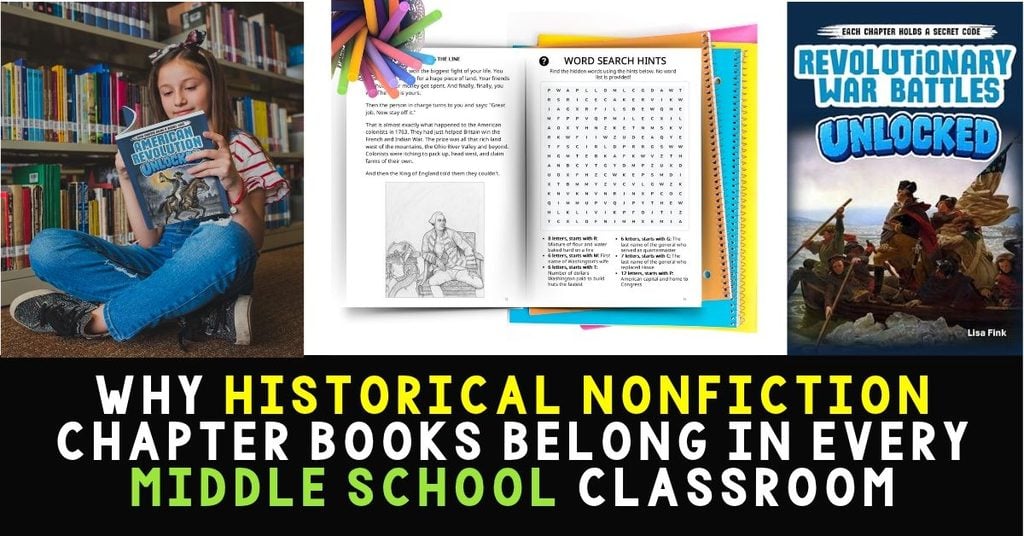
The short answer: Historical nonfiction chapter books help middle schoolers understand and remember history because they tell it as a story. Research shows students recall narrative text better than textbook-style writing, and reading whole books aloud can boost comprehension, especially for struggling readers. Look for books with an engaging voice, short chapters, and built-in checks for understanding.
Key Takeaways
- Students remember stories better than textbook-style passages, a finding backed by a 2021 meta-analysis of 37 studies.
- Reading whole, challenging books aloud helped struggling 12- and 13-year-olds gain 16 months of reading comprehension in 12 weeks.
- Background knowledge drives comprehension, and narrative history builds it.
- The author’s tone matters. A voice that sounds like a person, not a textbook, keeps students reading.
Ask a room of middle schoolers what history class is like, and you’ll probably hear the same answer: boring. Dates to memorize. Long paragraphs in a heavy textbook. Questions at the end of the section.
Now ask them about the last story that kept them up past bedtime. Their whole faces change.
That gap is exactly why historical nonfiction chapter books matter. History is already a story, full of real people, high stakes, and surprising twists. When we teach it like a story, students lean in. In this post, I’ll share what the research says about narrative nonfiction, why read-alouds still belong in middle school, why the author’s voice makes or breaks engagement, and how to choose books that actually work in your classroom or homeschool.
Why Are Historical Nonfiction Chapter Books Important in Middle School?
Middle school is when students shift from learning to read to reading to learn. Suddenly they’re expected to understand dense content in social studies and science, often from textbooks written for adults. Historical nonfiction chapter books bridge that gap. They deliver real facts, dates, and people, but in a format students already know how to enjoy.
They also build background knowledge, which turns out to be one of the biggest factors in reading comprehension. In a well-known 1988 study, researchers Donna Recht and Lauren Leslie gave 7th and 8th graders a passage about a baseball game. Weak readers who knew a lot about baseball understood it better than strong readers who didn’t. As one research summary puts it, “Knowledge of the topic had a greater impact on reading comprehension than generalized reading ability” (Achieve the Core).
Every historical nonfiction book a student reads adds to that knowledge. A student who has followed the road from the Stamp Act to Lexington doesn’t just know more history. They’re better prepared to read the next primary source, article, or textbook chapter on the topic.
Why Do Students Remember History Better When It’s a Story?
Our brains are built for stories. Cognitive scientist Daniel Willingham calls stories “psychologically privileged” because they are easier to understand, easier to remember, and more interesting than other kinds of text. In his article for American Educator, he notes that people “remember about 50 percent more from the stories than from the expository passages” (Willingham, 2004).
A larger body of research backs this up. A 2021 meta-analysis combined 37 studies with more than 33,000 participants and found that “stories were more easily understood and better recalled than essays” (Mar et al., 2021).
Why does story work so well? Willingham points to four ingredients, which he calls the “four Cs”:
- Causality: One event leads to the next, so students can follow the chain.
- Conflict: Someone wants something, and something stands in the way.
- Complications: Problems pile up and raise the stakes.
- Character: Real people make choices students can judge and debate.
History has all four built in. The Sugar Act causes anger, which leads to the Stamp Act protests, which leads to the Boston Massacre. When a book follows that chain the way a story does, students don’t have to memorize isolated facts. They remember what happened because they understand why it happened.
Why Does the Author’s Tone Matter So Much?
Two books can cover the exact same facts and get completely different results. The difference is voice.
Most history textbooks are written in a flat, faceless style. Education researcher Richard Paxton described this as “the relative silence of authorial voices” in history textbooks, and argued that it helps explain why students come away with such a thin understanding of the past (Paxton, 1999). When no one seems to be talking to the reader, there’s no reason to keep listening.
Compare these two ways to open a chapter on George Washington’s first command:
- Textbook voice: “In June 1775, the Second Continental Congress appointed George Washington commander in chief of the Continental Army.”
- Story voice: “Imagine you have just been handed the most important job in the country. You are now the leader of an army, and your task is to defeat the most powerful military on earth.”
The second one comes from Revolutionary War UNLOCKED for Kids, and it does something the first one can’t. It puts the reader in Washington’s boots. Now students want to know what he found when he showed up.
That interest isn’t just nice to have. A 2023 meta-analysis of reading motivation programs found that “interventions that aimed to trigger interest had positive effects” on both motivation and reading comprehension (van der Sande et al., 2023). Engagement is part of how students learn, not a break from it.
Good narrative nonfiction still respects the facts. The voice is friendly, but the history is accurate. The best books also tell students when a famous story might not be true, which teaches them to think like historians.
Should You Read Nonfiction Aloud in Middle School?
Yes. Many teachers drop read-alouds after elementary school, but middle schoolers still benefit, and plenty of them still enjoy it.
In one UK study, 20 English teachers read two whole, challenging novels aloud to 12- and 13-year-olds at a faster pace over 12 weeks. Students made an average of 8.5 months’ progress in reading comprehension, and poorer readers made a “surprising 16 months progress” (Westbrook et al., 2019). That study used novels, but the lesson carries over to narrative nonfiction: hearing a whole, rich book read well helps students understand more than they could read alone.
Many middle school teachers already know this. In a survey reported by Education Week, 344 of 476 middle school teachers said they read aloud to their students, and researcher Lettie Albright noted that the practice builds students’ knowledge in content areas (Education Week). Kids like it too. Scholastic’s Kids & Family Reading Report found that more than 80% of kids and parents love or like read-aloud time a lot (Scholastic).
Read-alouds are especially helpful for nonfiction because:
- Everyone gets the same background knowledge, no matter their reading level.
- You can model how to read hard text, pausing to explain a term or point out a cause and effect.
- Struggling readers can access grade-level history without being held back by decoding.
- Discussion happens naturally. You can stop at a cliffhanger and ask, “What would you do?”
Try this: Read the first half of a chapter aloud to hook students, then let them finish it independently or with a partner. Short chapters make this easy to fit into a single class period.
What Are the Benefits of Chapter Books Over Textbooks?
Textbooks and short articles have their place, but a full chapter book offers things they can’t.
- The whole story, in order: A chapter book follows one thread from start to finish, so students see how each event causes the next instead of jumping between disconnected sections.
- Built-in pacing: Chapters are natural stopping points. One chapter fits one class period or one homeschool day.
- Reading stamina: Finishing a whole nonfiction book builds the endurance students need for longer texts in high school.
- A sense of accomplishment: “I read the whole book” feels very different from “I read pages 214 to 219.”
- Cliffhangers that pull students forward: A good chapter ends with a question students want answered, which is something a textbook section almost never does.
- Easy differentiation: Advanced readers can read ahead, while others listen to the read-aloud. Everyone stays on the same story.
- Cross-curricular power: One book can cover social studies content and ELA standards like main idea, cause and effect, author’s purpose, and citing evidence.
Chapter books also pair beautifully with primary sources. Once students know the story, documents like Paul Revere’s Boston Massacre engraving or Patrick Henry’s speech suddenly make sense. (For 20 free primary sources matched to American Revolution UNLOCKED, see our post on American Revolution primary sources for kids.)
What Should You Look for in a Historical Nonfiction Chapter Book?
Not every “history book for kids” works in a classroom. Use this checklist before adding one to your shelf:
- A voice that talks to the reader, not at them. Read the first page aloud. Does it sound like a person or a textbook?
- Accurate, well-sourced facts. Look for a source list from trusted institutions like museums, archives, and national parks.
- Short, focused chapters that each cover one event or idea.
- Honesty about myths and legends. Great books separate what we know from what people just say happened.
- Multiple perspectives, including women, enslaved people, and Native nations, not just famous generals.
- Built-in comprehension checks like questions, puzzles, or activities at the end of each chapter.
- An answer key, so teachers, subs, and homeschool parents can check work quickly.
- The right reading level for your students, ideally readable independently and rich enough to read aloud.
American Revolution UNLOCKED + Revolutionary War UNLOCKED
by Lisa Fink. 24 story-packed chapters from 1754 to 1783, a puzzle after every chapter, and full answer keys. Perfect for grades 4 to 7.
Book 1 on Amazon Book 2 on Amazon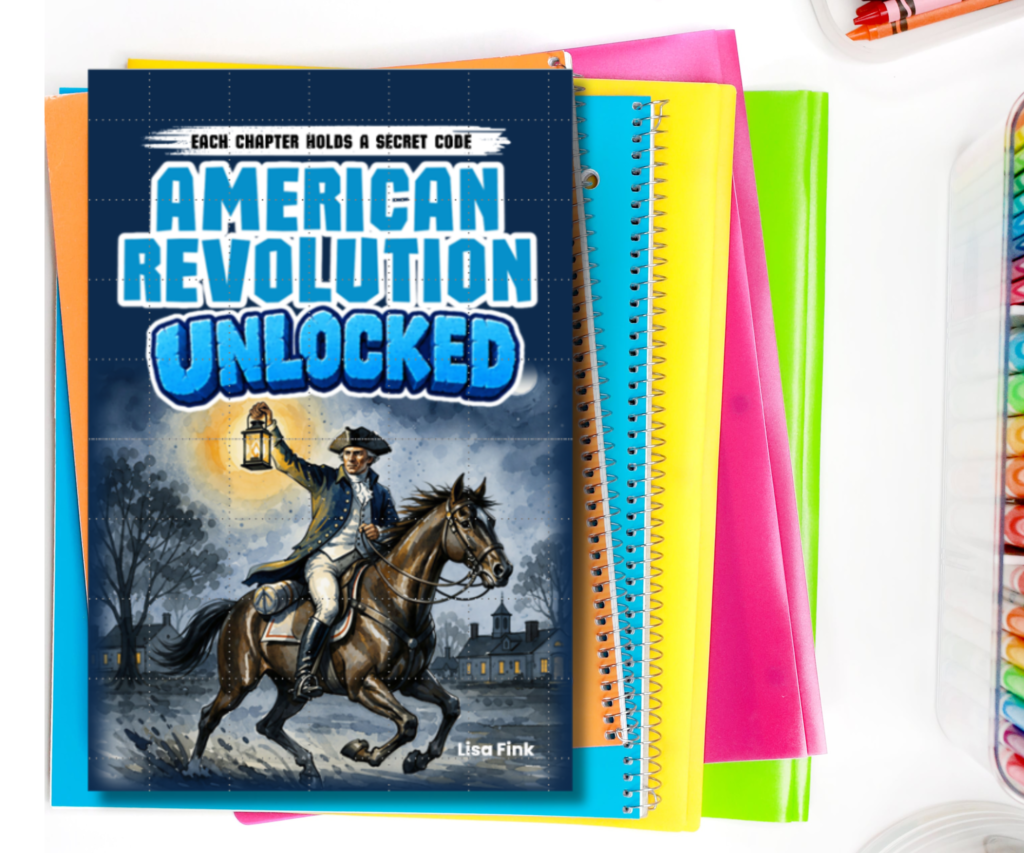
Why Both UNLOCKED Books Belong on Your Library Shelf
American Revolution UNLOCKED for Kids and Revolutionary War UNLOCKED for Kids by Lisa Fink were written to check every box on that list. Together, they tell the full story of America’s fight for independence, from 1754 to 1783, in 24 story-driven chapters for grades 4 to 7.
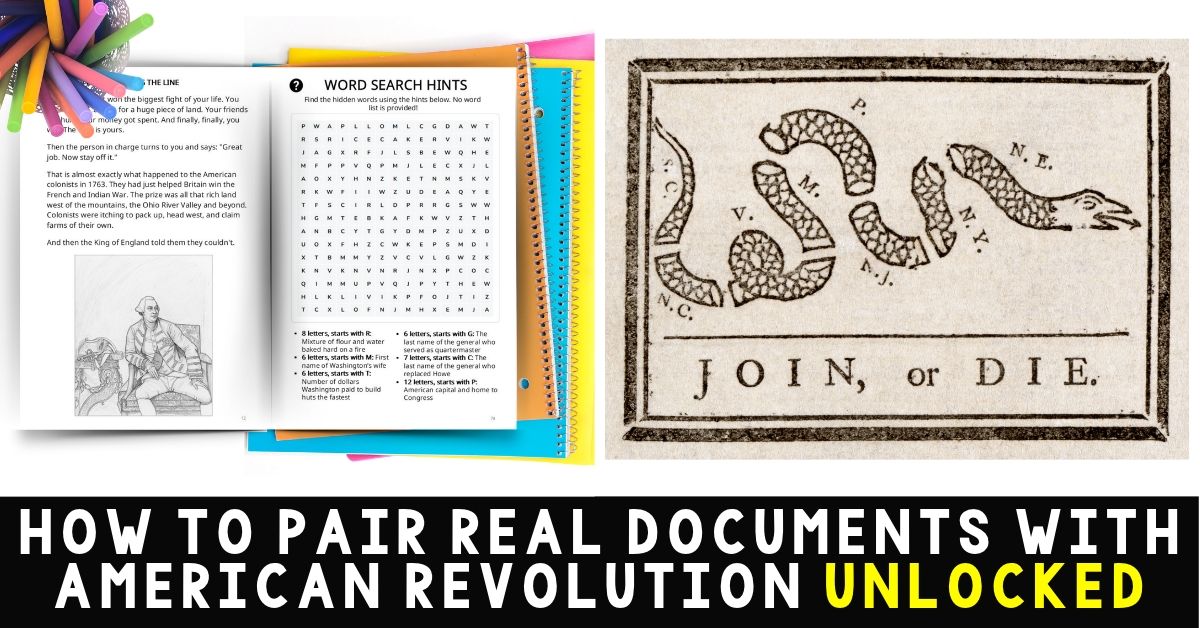
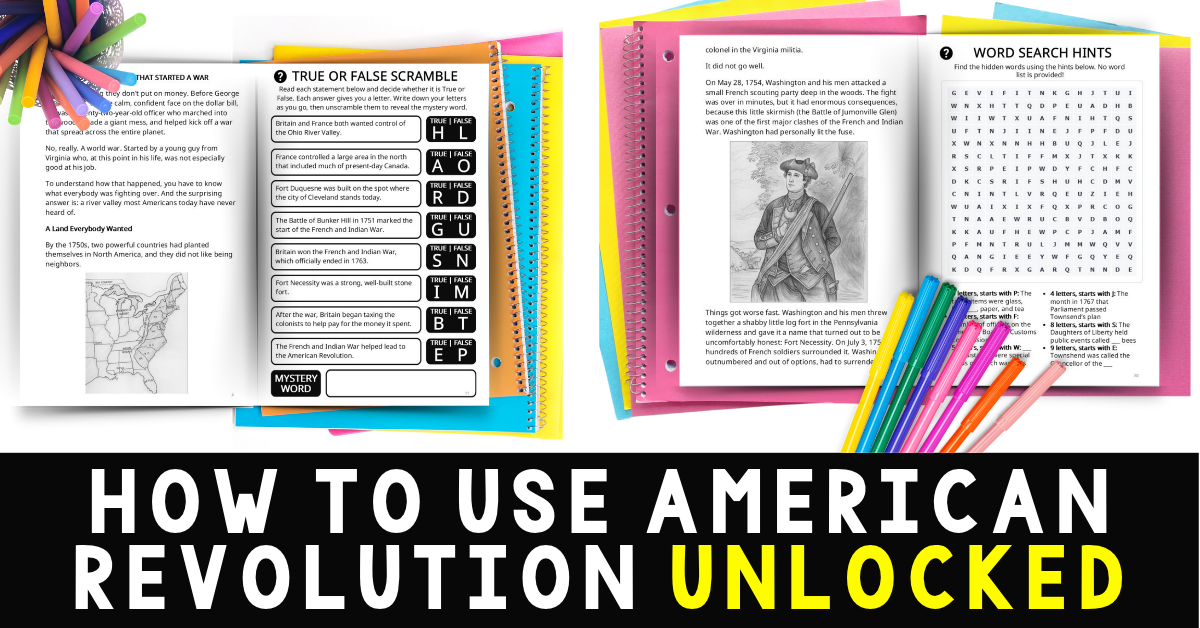
Book 1: American Revolution UNLOCKED for Kids sets the stage. It opens with a 22-year-old George Washington helping to spark the French and Indian War, then follows the road to revolution through the Proclamation of 1763, the Sugar and Stamp Acts, the Sons of Liberty, the Boston Massacre, the Boston Tea Party, and the shots fired at Lexington and Concord. Students finish knowing exactly why the colonies went to war.
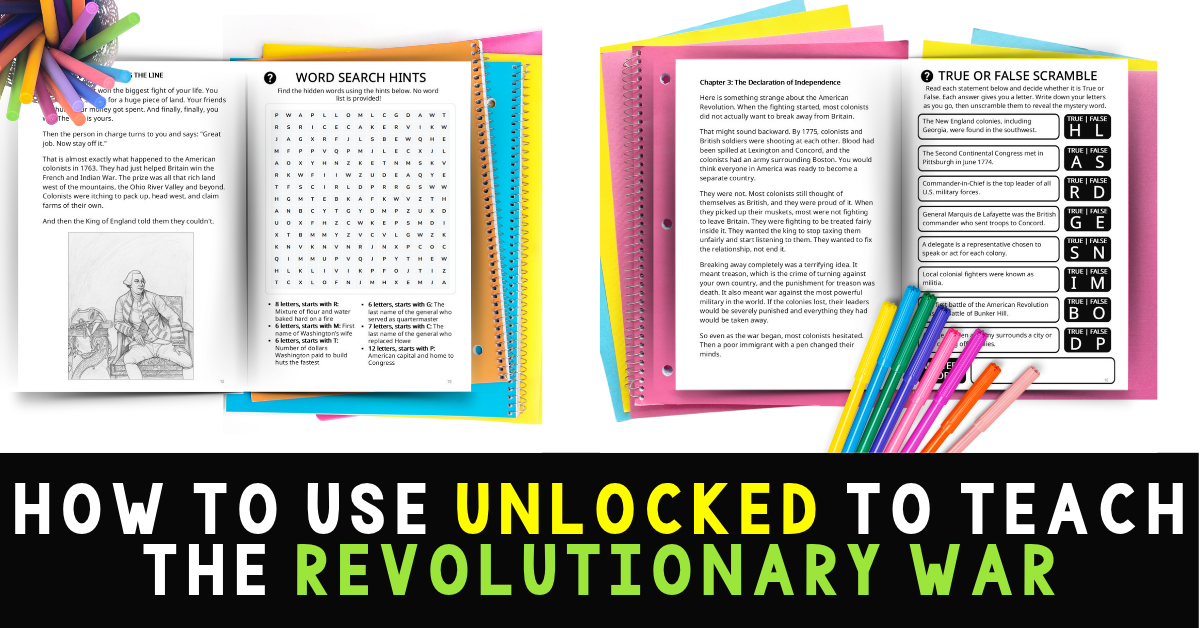
Book 2: Revolutionary War UNLOCKED for Kids picks up right where Book 1 ends. Students follow Washington as he turns a ragged crowd of farmers into an army, then live through Bunker Hill, the Declaration of Independence, the crossing of the Delaware, Saratoga, Valley Forge, Benedict Arnold’s betrayal, the war in the South, Yorktown, and the Treaty of Paris. A full chapter covers the enslaved people, women, and Native nations history nearly left out.
Here’s what makes the series work so well in classrooms and homeschools:
- A voice kids actually like: Each chapter reads like a story, with hooks, humor, and cliffhangers, never like a textbook.
- “The Story Goes” pages: Every chapter ends with a famous legend, like Molly Pitcher or John Paul Jones shouting “I have not yet begun to fight!”, and asks students what historians can actually prove.
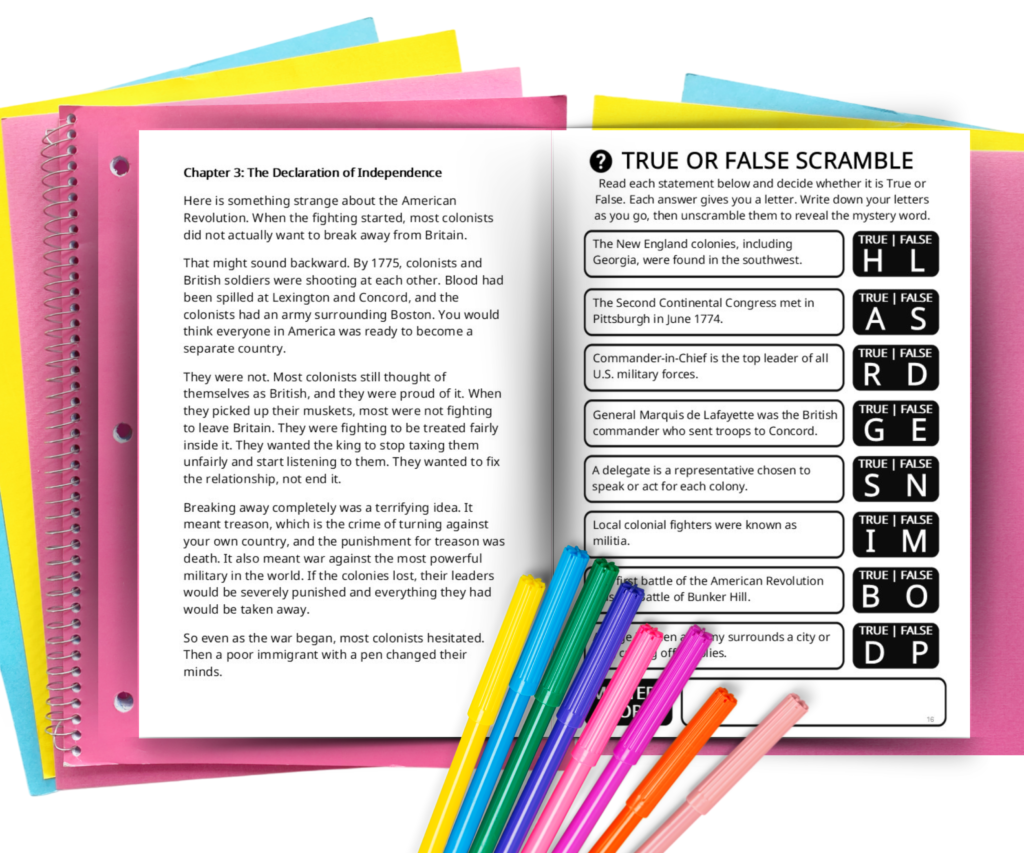
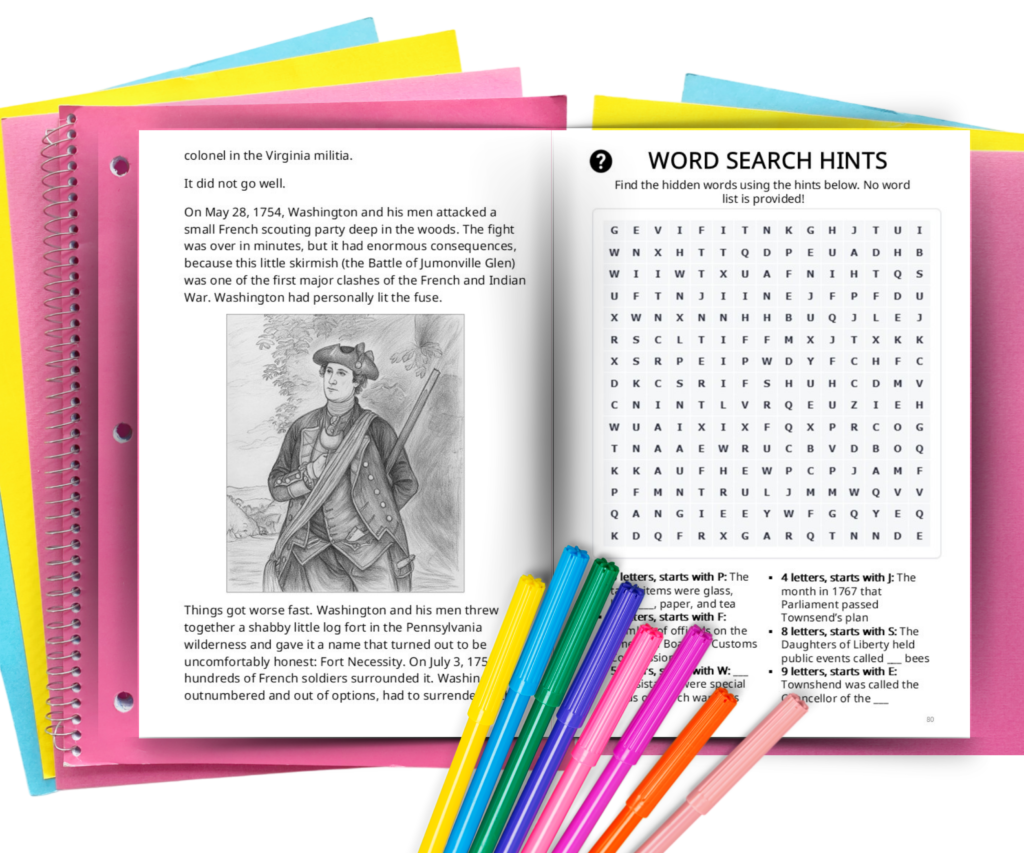
- A puzzle after every chapter: True or False Scrambles, Lock Riddles, Multiple Choice mystery words, and Word Search Hints check comprehension in a way that feels like a game.
- A full answer key: Perfect for busy teachers, substitute plans, and homeschool parents.
- Trusted sources: Both books list the museums, archives, and historic sites behind the research.
- Read-aloud ready: Short chapters and a lively voice make them easy to read aloud in one sitting.
Buy Book 1 first if you’re starting a unit on the causes of the Revolution, or get both for a complete American Revolution unit from start to finish.
Get Book 1 on Amazon Get Book 2 on Amazon
Try Chapter 1 for Free
Want to hear the voice for yourself before you buy? You can read Chapter 1 of American Revolution UNLOCKED for Kids for free and see the reading level and the author’s story-first tone up close.
Just scroll to the bottom of our post, Teaching the American Revolution, and sign up with your name and email. We’ll send Chapter 1 straight to your inbox. Try reading the first page aloud to your class and watch what happens.
Frequently Asked Questions
What is a historical nonfiction chapter book?
A historical nonfiction chapter book tells the true story of a real event or time period, divided into chapters like a novel. Unlike historical fiction, it doesn’t invent characters or events. Unlike a textbook, it follows one story from beginning to end in an engaging, narrative voice.
Why is narrative nonfiction good for middle school students?
Narrative nonfiction is easier to understand and remember than textbook-style writing. A 2021 meta-analysis of 37 studies found that students understand and recall stories better than expository texts. It also builds background knowledge, which research shows has a big effect on reading comprehension.
Should middle school teachers still read aloud?
Yes. Reading aloud gives every student access to grade-level content, models how to read challenging text, and sparks discussion. In one study, 12- and 13-year-olds whose teachers read whole, challenging novels aloud gained an average of 8.5 months in reading comprehension in 12 weeks, and struggling readers gained 16 months.
How do you keep middle schoolers engaged in history?
Teach history as a story with real people, conflict, and cause and effect. Choose books with a lively, personal voice instead of a textbook tone, stop at cliffhangers to discuss, and add hands-on elements like puzzles, primary sources, and debates.
What grade level are the UNLOCKED books for?
American Revolution UNLOCKED for Kids and Revolutionary War UNLOCKED for Kids are written for grades 4 to 7. They work as independent reading, read-alouds, literature circles, or a homeschool history spine.
Do I need to read the UNLOCKED books in order?
It’s best to start with American Revolution UNLOCKED for Kids, which covers the causes of the Revolution from 1754 to 1775. Revolutionary War UNLOCKED for Kids picks up in 1775 and follows the war to the Treaty of Paris in 1783. Each book can stand alone, but together they tell the complete story.
Conclusion
Middle schoolers don’t hate history. They hate history that sounds like a textbook. When we hand them true stories told in a real voice, read some of those stories aloud, and let them follow events from cause to effect, they understand more, remember more, and want to keep reading.
Historical nonfiction chapter books make that possible, and the research backs it up. If you’re building a classroom library or planning an American Revolution unit, start with two books that were written to be read, not just assigned.
Get Book 1 on Amazon Get Book 2 on Amazon
About the Author
Lisa Fink is the creator of Think Tank Teacher, which makes engaging social studies and science resources for upper elementary and middle school classrooms. She is the author of American Revolution UNLOCKED for Kids and Revolutionary War UNLOCKED for Kids, story-driven history books with built-in puzzles for grades 4 to 7.
Sources
- Mar, R. A., Li, J., Nguyen, A. T. P., & Ta, C. P. (2021). Memory and comprehension of narrative versus expository texts: A meta-analysis. Psychonomic Bulletin & Review.
- Willingham, D. T. (2004). The Privileged Status of Story. American Educator.
- Recht, D. R., & Leslie, L. (1988). Effect of prior knowledge on good and poor readers’ memory of text. Journal of Educational Psychology. Summarized by Achieve the Core.
- Westbrook, J., Sutherland, J., Oakhill, J., & Sullivan, S. (2019). ‘Just reading’: the impact of a faster pace of reading narratives on the comprehension of poorer adolescent readers in English classrooms. Literacy.
- Education Week (2010). Reading Aloud to Teens Gains Favor Among Teachers.
- Scholastic (2019). Kids & Family Reading Report: The Rise of Read-Aloud.
- van der Sande, L., et al. (2023). Effectiveness of Interventions that Foster Reading Motivation: A Meta-analysis. Educational Psychology Review.
- Paxton, R. J. (1999). A deafening silence: History textbooks and the students who read them. Review of Educational Research.