Would you believe ChatGPT wrote this haiku about the Boston Tea Party in a fraction of the time it took me to write this sentence?
Swiftly crafted, historically inspired haikus aren’t the only benefits teachers can reap from ChatGPT, an artificial intelligence language model developed by OpenAI. Read on to learn how AI can be a game-changer for lesson planning.
What is ChatGPT?
This state-of-the-art natural language processing model set the internet ablaze with its 2022 debut. The AI bot generates human-like responses to text-based prompts, such as questions or conversation starters.
GPT stands for “Generative Pre-trained Transformer,” which refers to the model’s architecture. ChatGPT is pre-trained on vast amounts of text data, and users can refine requests to perform specific tasks, such as summarization, question-answering, or translation.
In short, ChatGPT is an advanced AI model that can engage in human-like conversations and generate text-based responses that are often difficult to distinguish from those written by a human.
9 ways ChatGPT increases lesson planning efficiency
Upper elementary teachers can use ChatGPT in various ways to streamline their lesson prep methods. Check out these suggestions:
- Outlining lessons: Use ChatGPT to jumpstart your lesson plans with an outline. Input learning objectives, topics you will cover, and any other relevant information, and the bot will create a customizable framework that will fit students’ needs.
- Compiling discussion topics: The tool can generate lists of talking points related to your planned lesson. Enter the subject matter, and ChatGPT will provide related questions to spark discussion.
- Suggesting collaboration tips: Speaking of sparking discussion, ChatGPT can recommend ideas for developing teamwork and social skills. Input the focus skill and grade level for fresh ideas on how to help your students collaborate actively and enthusiastically.
- Finding resources: Searching for the perfect resources for your next lesson? Just type in keywords related to what students will be learning, and ChatGPT will provide a list of relevant resources, such as articles, videos, and interactive tools.
- Rewriting articles: Let’s say you discovered an excellent article for an upcoming science lesson, but you think it might be a little complex for your 5th graders. ChatGPT can rewrite the material and change the reading level, making it more accessible for your classes.
- Creating reading passages: Whether you need a fictional text on a 4th-grade reading level or a nonfiction article about Ancient China for your 6th-graders, all you have to do is input your request, and ChatGPT will produce engaging, on-level text for your students. It can even help you target specific text structures like cause and effect or compare and contrast.
- Producing project ideas: Are you tired of assigning the same book reports year after year? Do you need recommendations for authentic student assessments? The bot can generate a list of suggested projects to help your students show what they know.
- Sourcing new tech tools: If you’re looking for new and novel ways to incorporate technology into your lessons, ChatGPT has you covered. Not only does the tool suggest new ways to use tech to enhance student engagement and learning, it also helps you compare and contrast tools and can even create support guides to help your students get the most out of the tools they’re using.
- Generating assessment questions: From exit tickets to multiple-choice quizzes and practice tests, you can use ChatGPT to create assessment questions related to your lesson plans. Input the topic you will cover, and ChatGPT will list potential questions for quizzes, tests, or other assessments.
Overall, ChatGPT can be a valuable tool for teachers, offering numerous benefits that can help streamline their lesson planning and improve the effectiveness of their teaching. However, it does have limitations and disadvantages.
Grab a FREE ChatGPT Teacher Prompts Quick Start Guide below!
Drawbacks of ChatGPT
While ChatGPT can help you explore new instructional ideas while also saving you time, there are also potential pitfalls that you should be aware of:
- Limited creativity: Relying too heavily on ChatGPT to generate lesson plans and content can limit your creativity and ability to think outside the box.
- Lack of human touch: While ChatGPT can generate human-like responses, it lacks the emotional intelligence and personal touch that a human teacher can provide, an essential aspect of effective teaching.
- Over-reliance on technology: Leaning too heavily on technology can be detrimental if there is a technical issue or if you become too dependent on the AI bot, leading to difficulties in planning lessons without it.
- Inaccuracy: While ChatGPT is advanced, it’s not perfect and can sometimes generate incorrect or inappropriate responses, which can be problematic in a classroom setting. Also, the tool’s knowledge of world events after 2021 is limited.
- Ethical concerns: Ethical concerns exist with the use of AI in education, such as the potential for biases, including racism and sexism, as well as concerns about privacy and data security.
While ChatGPT can be a valuable tool for teachers that helps them save time and plan more efficiently, it should not be relied on exclusively. Upper elementary teachers should balance its use with their expertise and experience to ensure effective and engaging lesson planning.
How to harness the power of ChatGPT during lesson planning
If you want to use this tool to its fullest extent, the key is to be specific.
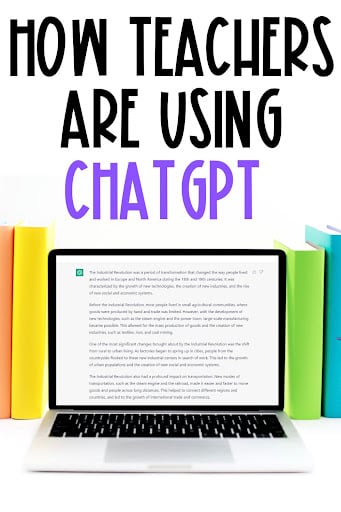
ChatGPT can be fine-tuned to particular topics, so teachers should customize the prompts and inputs to suit their needs and ensure the generated responses are relevant to the lesson they are planning. To fine-tune prompts with the AI bot, teachers can:
Use specific vocabulary: Include particular vocabulary related to the teaching topic to help ChatGPT generate more relevant responses. Do this by including relevant keywords in the prompt or input text.
- Prompt example: Write about the food chain.
- Refined prompt: I want my 5th-grade students to understand how matter moves in food chains. Write a beginner’s guide in language they’ll understand.
Narrow the scope: Hone in the range of the generated responses by specifying the type of response needed. For example, instead of asking a general question about a topic, you could ask a more specific question to narrow the focus of the output.
- Prompt example: Write a reading passage about flowers and their functions.
- Refined prompt: Write a short fiction reading passage about flowers and their functions at a 700 Lexile level.
Adjust the length of the prompt: The length of the prompt can also impact the relevance of the generated response. Teachers can experiment with different prompt sizes to find the optimal length that produces the most relevant answers.
- Prompt example: Write about the causes and effects of deforestation.
- Refined prompt: Write a 500-word article about the causes and effects of deforestation in the Amazon Rainforest for my 6th graders.
Provide context: Providing context for the prompt can also help ChatGPT generate more relevant responses. Try providing background information or framing the prompt in the context of the lesson or learning objectives.
- Prompt example: Write 5 true or false questions about biomes.
- Refined prompt: My 5th-grade students need to identify different kinds of biomes. Write 5 true or false questions about biomes to check for understanding.
Refine the model: Enhance requests by training the AI bot on specific text data related to your teaching topic. Simply upload relevant text documents or web pages to the model to fine-tune its understanding of the topic.
- Prompt example: Project ideas about the purpose of government
- Refined prompt: Give me 10 project ideas for research projects that 6th-grade students can complete about the purposes of government. (Paste any information components of your lesson plan, such as content outlines or reference materials to generate questions based on the material you have taught in the particular unit.)
With great AI comes great responsibility
There’s no doubt ChatGPT is an incredible tool with the potential to revolutionize the way teachers plan instruction. It can also help you spend less time prepping lessons and more time doing other things like spending time with your family or practicing self-care.
However, AI bots like ChatGPT are tools to help teachers. They do not replace the expertise gained through years in the classroom. It’s important to remember the limitations of artificial intelligence and always keep an eye out for inaccurate or biased output.
How will you use ChatGPT to enhance your lesson planning? Do you view artificial intelligence as a troubling trend or a powerful time-saver?
How will you use ChatGPT to enhance your lesson planning? Do you view artificial intelligence as a troubling trend or a powerful time-saver?


One Comment
Hi Lisa, Thank you. I’m find your content so interesting at the moment. I have been experimenting with prompts for Chat GPT. It’s an amazing tool, but as you said, it does have its limitations – I asked it to generate some two step equations which had a solution of between 0 and 10 and gave it the format to follow and almost half of them were incorrect.
It’s great at writing poetry though – wrote a lovely one for my sister’s birthday card!
Many thanks again for the information and advice.